This whole project started with a gap we couldn't ignore. While building our product, we went looking for illustrations and icons that showed people with disabilities in successful roles at work, alongside people without disabilities, and there was almost nothing out there. What did exist mostly seemed to show someone with a disability sitting alone in a dark room, staring sadly into the distance. If there's one thing our participants have told us again and again, it's that they don't want your pity. Empathy over sympathy, every time.
Keep looking and you'll find a handful of disability focused illustration libraries. Very few of them extend that same style to people without disabilities, or to people of different cultures. And there's even less choice again once you're looking for something professional rather than cutesy clip art.
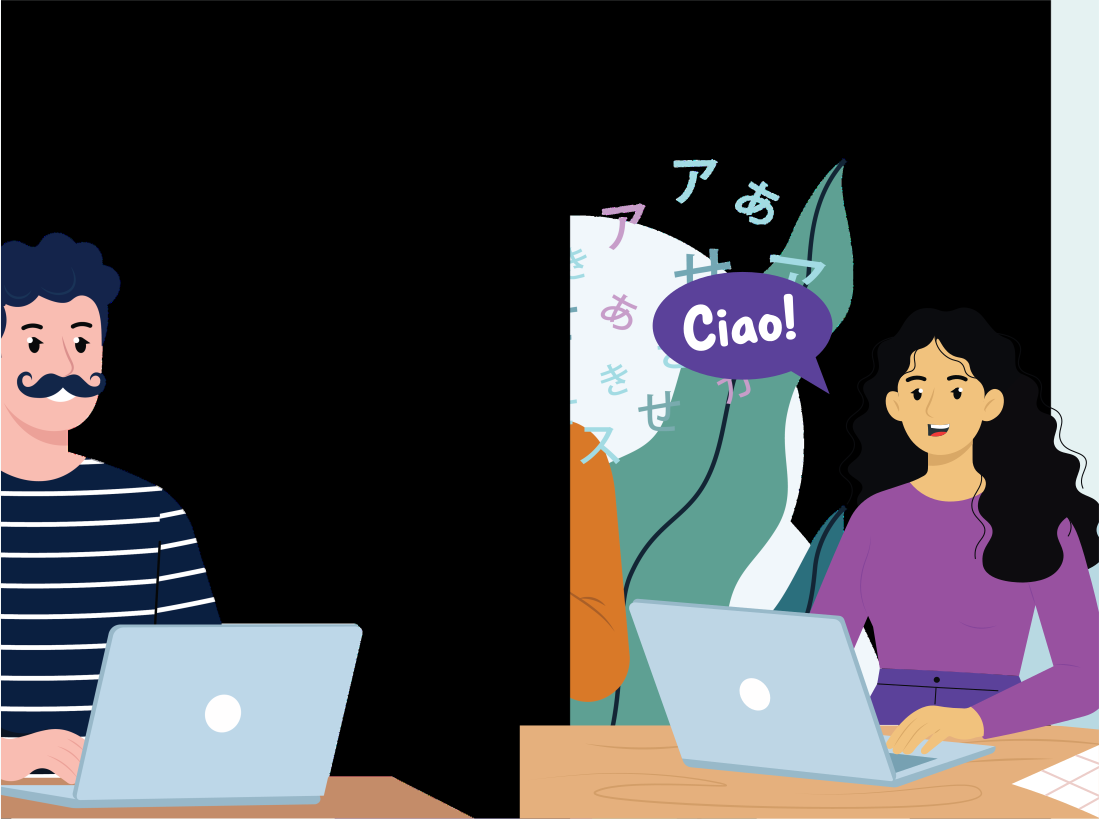
So that's what we did. We're a tiny, early stage startup, and we've invested in a suite of custom illustrations that we're now making freely available to anyone who wants them, open source and at no cost. No pity party in any of them, and every asset is co-designed with the people it represents. It's the small details that matter here: not just someone at work in a wheelchair, but someone at work in a power wheelchair too.
We're genuinely comfortable talking about inclusive language. We spend our days encouraging organisations to focus on respectful language, and to ask the person if they're ever unsure, rather than defaulting to overly positive framing, or avoiding the words altogether. But building this library put us in front of a question we hadn't had to answer before: how do we represent different cultures respectfully, at scale, across hundreds of illustrations? That's what the rest of this page is about, sharing our research and the approach we landed on.
We're learning as we go, and we mean well. If we get something wrong here, please tell us.
Nobody sets out to get this wrong. Most people who hesitate over how to describe someone's background, particularly when it comes to how they look, aren't being careless, they're being careful, and that carefulness is exactly the instinct that makes vague language feel safer than specific language.
For example, take See Me Please's open source Inclusive Images Library. Search tags that describe a photo of a Samoan woman as simply "diverse" mean nobody searching for Pacific representation will ever find her, and we'll never know if we're missing that representation in the first place. The exact gap we observed, a lack of inclusive, person first representation, isn't solved, because no one can find an image that reflects what they're looking for.
Respect and specificity aren't in tension. They're the same instinct, pointed at the same goal: seeing people accurately, and letting them be found. Many people avoid specific terminology for fear of offending someone, and in this case, avoidance is the enemy.
Every country that runs a census has to answer the same question we're answering here, and they've each landed somewhere slightly different. It's worth knowing the landscape before picking a standard, because the differences are the whole story, and the links below are there so you can look at each one yourself and decide what fits your own project, not just take our word for it.
- The UK's Office for National Statistics (opens in a new tab) groups its 2021 Census into 19 categories, from "Bangladeshi" to "Gypsy or Irish Traveller" to "Any other ethnic group." It's public, revised by public consultation, and it's the size our page used before this rewrite.
- The US Office of Management and Budget's Statistical Policy Directive No. 15 (opens in a new tab) just finished its first rewrite since 1997. The 2024 revision collapsed race and ethnicity into one combined question and added "Middle Eastern or North African" as its own category for the first time, landing on 7 minimum categories.
- Stats NZ's ethnicity classification (opens in a new tab) starts broad (6 categories: European, Māori, Pacific peoples, Asian, MELAA, Other) and lets you drill down to 233 at its most detailed level, a genuinely elegant way to serve both a quick census form and a researcher who needs precision.
- Statistics Canada's "visible minority" list (opens in a new tab), used for Employment Equity Act reporting, is worth a special mention: it deliberately keeps Aboriginal peoples out of that list entirely, in their own protected category, rather than folding a colonised people's identity into a catch-all "minority" bucket. That's a design decision with real ethical weight behind it, not an oversight.
- The Australian Bureau of Statistics' ASCCEG (opens in a new tab) is the deepest of the lot: 9 broad groups, 28 narrow groups, and 276 named cultural and ethnic groups underneath those, first published in 2000 and kept current with a minor review as recently as 2025.
None of these is "more correct" than the others. They're built for different jobs: a census needs different granularity to a hospital intake form, which needs different granularity again to an illustration library trying to make sure nobody searching for their own community comes up empty.
| Framework | Category count | Scope | Verdict |
|---|---|---|---|
| Australian Standard Classification of Cultural and Ethnic Groups (ASCCEG)Chosen | 276 detailed groups (9 broad, 28 narrow) | Australian Bureau of Statistics standard, most recently revised 2025 | Chosen: the most rigorously maintained standard of the group, and specific enough to name individual peoples (e.g. Samoan), not just a broad region. |
| UK ONS 2021 Census ethnic group classification | 19 categories | UK national census, publicly documented, revised via public consultation | Considered, and used by an earlier version of this page. Browsable, but not specific enough to distinguish, for example, Samoan from Pacific Islander generally. |
| US OMB Statistical Policy Directive No. 15 (2024 revision) | 7 minimum categories | US federal statistical standard, revised 2024 (added a Middle Eastern/North African category) | Considered, but too coarse for representation search and filtering. |
| Stats NZ ethnicity classification | 6 categories at Level 1, up to 233 at Level 4 | New Zealand official statistics standard, four-level hierarchy | Considered: the same broad-to-detailed structure we ended up wanting, just for a different country. |
| Statistics Canada "visible minority" classification | 13 categories | Canadian Employment Equity Act reporting standard | Considered: notable for deliberately excluding Aboriginal peoples from the "visible minority" list entirely, a design choice worth understanding even though we didn't adopt this standard. |
The 9 broad groups and 28 narrow groups, transcribed directly from the ABS's own published structure, exactly as the ABS groups them:
Oceanian
- Australian Peoples
- New Zealand Peoples
- Melanesian and Papuan
- Micronesian
- Polynesian
North-West European
- British
- Irish
- Western European
- Northern European
Southern and Eastern European
- Southern European
- South Eastern European
- Eastern European
North African and Middle Eastern
- Arab
- Jewish
- Peoples of the Sudan
- Other North African and Middle Eastern
South-East Asian
- Mainland South-East Asian
- Maritime South-East Asian
North-East Asian
- Chinese Asian
- Other North-East Asian
Southern and Central Asian
- Southern Asian
- Central Asian
Peoples of the Americas
- North American
- South American
- Central American
- Caribbean Islander
Sub-Saharan African
- Central and West African
- Southern and East African
Underneath these 28 narrow groups sit 276 named, detailed cultural and ethnic groups, like "Samoan" under Polynesian, or "Torres Strait Islander" under Australian Peoples. We link to the source rather than reproducing all 276 rows on this page: browsable at this level, available in full when precision is the point.
Read the full ASCCEG classification
The Australian Bureau of Statistics' own documentation for the ASCCEG structure, including the full 276-group data file.
Australia is home base for See Me Please, and the ABS runs the most actively maintained, most rigorously reviewed classification of the lot, revised on a public cycle with a formal consultation process behind every change, most recently in 2025.
We use the full ASCCEG, all 276 detailed cultural and ethnic groups underneath its 9 broad and 28 narrow groups, as our default. That's a deliberate choice for specificity over convenience: the whole point of the Samoan example above is that "Pacific" isn't a specific enough tag to be found by. A broader working set (even ABS's own 9 broad groups) would still only get a searcher as far as "Oceanian," the broad group Samoan sits under. The full 276-group classification is what actually gets a searcher to "Samoan." When a project genuinely only needs the broad picture, the coarser levels are still there inside the same standard, we're not asking anyone to memorise 276 terms, only to have them available when precision is the point.
The classification standards above answer "what are the categories." A separate, equally useful set of resources answers "what's the respectful way to talk about them," which is a different question with a different kind of answer. We keep an eye on a few of these as a secondary check on wording, not as a source of categories:
- The Diversity Style Guide (opens in a new tab), Built by journalism and DEI professionals. Our existing secondary check on individual term wording.
- Conscious Style Guide (opens in a new tab), Recommended by outlets including the Chicago Manual of Style and the Society of Professional Journalists.
- The Australian Government Style Manual's inclusive language guidance (opens in a new tab), Includes specific guidance on writing about First Nations people.
- APA's Inclusive Language Guide (opens in a new tab), Aimed at psychology and research writing, but broadly applicable.
None of these replaces a classification standard, and none of them is ours to edit. But if a term on this page ever reads as dated, one of these is very likely why, and they're worth bookmarking regardless of what you're writing.
Respect is a method, not a mood. Adopting an external standard doesn't mean we treat it as gospel. Every category we use still passes a community-review gate before it's used to tag a published asset, consistent with how every other representation value in the library is handled.
If a term ever reads as outdated by the time you read this, tell us. Language earns its keep by staying current, and a page like this one is only doing its job if it's willing to be rewritten again.
For the full taxonomy this facet sits within (subjects, categories, art styles, and the naming grammar used across the library), see the Cohorts reference for how SMP's six testing cohorts relate to the accessibility categories used throughout the platform.
Here's the part that's easy to miss: precise, standardised terminology isn't just the respectful choice, it's also the discoverable one. Someone searching "Aboriginal and Torres Strait Islander illustration" or asking an AI assistant to find "accessible design imagery representing South Asian users" is searching in the exact vocabulary a real classification standard uses. A generic tag like "diverse person" matches nothing specific, ranks for nothing specific, and gets recommended by nothing specific, not a search engine, and increasingly, not an AI answer engine trying to match a query to the right source either. The words a census bureau chose after years of public consultation tend to be the same words real people type into a search bar, which makes "use the standard, precisely" a rare case where the accessible choice and the SEO choice are the same choice.
The classification standards cited throughout this page, direct from source:
- UK Office for National Statistics, 2021 Census ethnic group classification (opens in a new tab)
- US OMB: Statistical Policy Directive No. 15 (2024 revision) (opens in a new tab)
- Stats NZ: ethnicity classification (opens in a new tab)
- Statistics Canada: "visible minority" classification (opens in a new tab)
- Australian Bureau of Statistics: ASCCEG, latest release (opens in a new tab)