Tag
User Research
Every published article tagged "User Research".
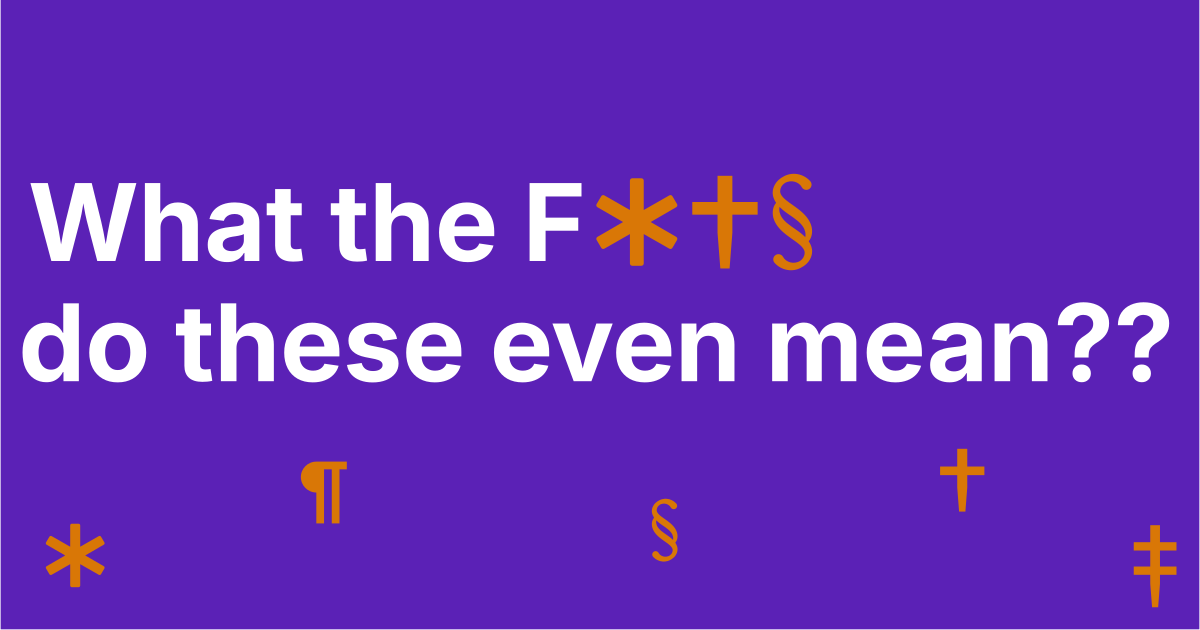
Insurance Footnotes Are Failing Customers: An Accessibility and Usability Review of Global Insurance Companies
The See Me Please Insurance Footnote Audit 2026 reviewed 62 targeted insurance pages across Australia, the United Kingdom, Ireland, the United States and the European Union, successfully measuring 53. The audit was prompted by recurring behaviour observed in user testing: customers across disability, age and language cohorts repeatedly struggled with footnotes while trying to understand price, cover, exclusions and conditions. We found pages using up to 96 markers, multiple symbol systems and qualifications separated from the claims they changed. The result is a disclosure pattern that can technically record information without reliably communicating it, creating universal-usability friction across insurance journeys.
Accessible ≠ Usable: Testing a Popular Design Maxim Against 1,580 Real Scores, and a Warning About How We Measure It
A research note from See Me Please | Data source: 1,580 tester-task scoring events across 13 usability studies, 2026
The Volatility Problem: Why an Average Accessibility Score Is Often the Least Trustworthy Number in the Report
A research note from See Me Please | Data source: 526 task-by-cohort score groups, 15 usability studies, 2026

Moderated vs Unmoderated User Research: Which One Actually Gets You the Truth?
Here's what the research actually shows, and how we decide which method to use, tester by tester.
Who said that, and is it normal for them?
Two questions that sound trivial, that most user testing platforms structurally cannot answer, and that between them decide whether anything you measure from a session transcript is valid or worthless. Here is the infrastructure we built to answer them, the hypothesis we built it to test, and an honest account of what we can and cannot yet claim.
The Say-Do Gap: Why Self-Reported Usability Scores Overstate Real-World Experience, and Why the Size of the Gap Depends on Who’s Reporting
Published by See Me Please | Data source: 125 paired raw-vs-calibrated scoring events (curated subset) and 1,500 paired raw-vs-calculated scores (full sample), across 15 usability studies, 2026
The Blind Spot in Self-Report: Why the Users With the Worst Measured Experience Rate It the Most Generously
A research note from See Me Please | Data source: 1,500 paired self-report and calculated scores across 15 usability studies, 2026

Comprehension, Not Just Access: Why Content Clarity Is the Most Frequently Flagged Usability Failure We Measure
Published by See Me Please | Data source: 15 independent usability studies, 5,733 approved individual test findings, 2026
What Breaks for Whom: Friction Patterns Across Nine Disability Cohorts in Usability Testing
Published by See Me Please | Data source: 15 independent usability studies, 3,197 cohort-tagged friction findings, 2026